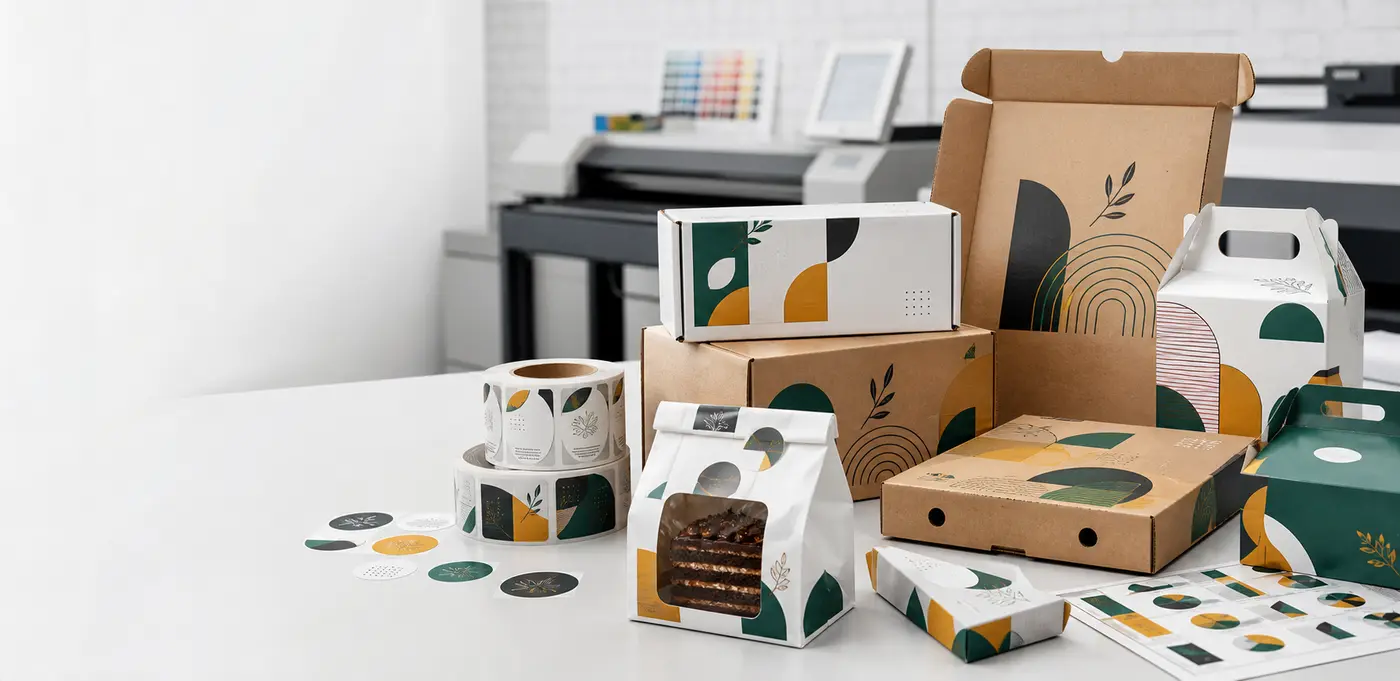
By prints.com.pk · Published July 20, 2026
If you sell online in Pakistan, you already know the drill: a product leaves your workspace looking perfect, and three days later a customer sends a photo of a crushed corner, a torn flap, or a box that arrived half-open. Before you assume it's a courier problem, it's worth asking a harder question — was the box ever built to survive that trip in the first place?
TCS, Leopards, and M&P move parcels through sorting facilities, delivery bikes, and stacked delivery vans, not curated shelves. A box that looks fine sitting on a table can fail completely once it's under three other boxes on a bike rack for two hours. Here's what actually determines whether your packaging holds up.
The Four Things That Actually Damage Packages in Transit
- Compression — boxes stacked on top of each other in a delivery van or sorting bin, for hours at a time.
- Impact — drops, tosses, and the general handling that happens when a rider is juggling twenty parcels on one run.
- Flex and twist — a box that isn't rigid enough bends when picked up by one corner, which is enough to crack a product inside even without an obvious drop.
- Moisture and dust — monsoon-season handling, damp bike storage, and dusty sorting floors, especially on multi-day routes to smaller cities.
Almost every damage complaint traces back to one of these four. The fix for each one is different, which is why generic "just use a stronger box" advice usually doesn't solve the actual problem.
Choosing the Right Board and Construction
Most of our e-commerce customers land on 3-ply corrugated kraft with roughly 150 PSI burst strength for mailer boxes — that's the point where a box resists compression without adding unnecessary weight (and courier pricing is often weight-based, so over-building costs you twice). If your product is heavier, denser, or you're shipping to farther cities with more handling touchpoints, moving to a thicker board or adding a double-wall construction on the base is worth the small cost increase.
For lighter, non-fragile items — clothing, soft accessories, anything that doesn't dent or crush — a padded poly mailer is often the smarter call. It weighs less (cheaper courier rates), and a good poly mailer with an internal bubble lining handles impact better than people expect. We cover exactly when to make that swap in our guide on poly mailers vs. boxes.
Self-Locking vs. Taped Boxes
Self-locking tab construction — where the box folds and interlocks without tape — isn't just a convenience feature. Taped boxes fail in a specific, predictable way: the tape bond weakens with heat and handling, and a box that was sealed tight at your workspace can pop open by the time it reaches a rider's bag on a hot afternoon. Self-locking tabs don't rely on adhesive at all, so they hold their shape and closure through the entire trip, including humidity swings that would otherwise loosen tape.
There's a packing-speed benefit too, which matters more than it sounds like once you're fulfilling more than a handful of orders a day. A self-locking box goes from flat to sealed in a few seconds with no tape gun, no waiting for adhesive to grip, and no risk of a rushed, half-stuck seal that opens in transit. If you're packing orders yourself at the end of a long day, that consistency matters as much as the raw strength numbers.
Sizing Your Box Correctly — the #1 Mistake We See
The single most common packaging failure isn't a weak box — it's the wrong size box. A box that's too large lets your product shift and slide during transit, and every impact becomes a direct hit instead of being absorbed by snug packing. A box that's too small gets over-stuffed, which stresses the seams and corners until they split under compression.
As a rule of thumb, your product should have no more than about half an inch of play in any direction once padding is added. If you're between two standard sizes, size up and add void fill rather than forcing a tight fit — a tightly wedged product still transmits shock straight through the box walls.
This is also where a lot of new sellers overspend without realizing it. Ordering one oversized box "to be safe" across your whole catalog means every shipment pays for cardboard, weight, and void-fill material it doesn't need. It's usually cheaper — and safer for the product — to stock two or three sizes matched to your actual SKU dimensions than to standardize on one box that's right for only some of what you sell. Our mailer box sizing guide walks through matching each of our six standard sizes to your actual SKUs in more detail.
Inserts, Padding, and Void Fill
For anything with corners that can crush (cake boxes, gift sets, jewellery) or edges that can bend (cards, prints, flat goods), a fitted insert does more for damage prevention than a thicker box ever will. It's why every one of our cake box and jewellery box styles ships with insert options — the insert holds the product rigid inside a box that still has some give, which is a much better combination than a rigid product loose inside a rigid box.
If your product doesn't have a natural insert shape, crumpled kraft paper or a simple cardboard divider is inexpensive and genuinely effective. Avoid loose plastic air pillows for anything shipping in hot weather — they lose pressure over multi-day routes and stop cushioning by the time the parcel actually arrives.
Printing That Survives — and Printing That Doesn't
Damaged-looking print is a different problem from a damaged box, but it hits your brand just as hard. Uncoated, low-DPI printing scuffs and fades with handling; it's why we print everything at 1440 DPI with Pantone-matched colour — the print sits crisper on the fiber and resists the surface abrasion that happens when boxes rub against each other in transit. If your artwork includes a barcode, courier label area, or fragile-handling icon, keep that away from box edges and fold lines specifically, since that's where abrasion concentrates first.
Seasonal Volume Spikes: Eid, Wedding Season, and Monsoon
Packaging that holds up fine in normal conditions can start failing during predictable stress periods. Eid and wedding season bring higher parcel volumes through courier networks — more stacking, longer sorting queues, more handling touchpoints before a package reaches the last-mile rider. Monsoon months add humidity and occasional water exposure on top of that. If a big share of your annual orders lands in one of these windows, it's worth testing your packaging under those specific conditions ahead of time rather than discovering the failure point during your busiest week.
A simple way to prepare: order a small batch of your packaging a few weeks before a known volume spike, ship a handful of test parcels to friends or past customers in different cities, and ask them to photograph the parcel on arrival before opening it. That single round of feedback tells you more about real-world handling than any spec sheet.
A Quick Pre-Shipping Checklist
- Product has no more than ½" of movement inside the box once padded
- Box uses self-locking or reinforced-tape construction, not a single strip of tape
- Fragile items sit inside a fitted insert, not loose against the box wall
- Board strength matches product weight and destination distance
- Any window cutouts or thin panels are reinforced or avoided for long-haul shipments
- You've tested one "worst case" shipment — smaller city, monsoon season — before scaling up
- Packaging is sized correctly per SKU rather than one oversized box for everything
Use Customer Damage Reports as Design Feedback, Not Just Complaints
If a customer reports a damaged parcel, ask for a photo before you refund or reprint — it's the fastest, cheapest packaging research you'll ever get. A pattern of the same corner failing across multiple reports points to a sizing or insert problem, not bad luck. A pattern of seams splitting points to board strength. Most sellers treat damage reports purely as a customer-service cost; a few extra minutes reading them as design data pays for itself the first time it stops a recurring failure before it happens fifty more times.
It's also worth tracking damage rate by destination city, if you ship nationwide. A box that performs fine on local Lahore deliveries but consistently arrives damaged on longer routes to smaller cities is telling you something specific about handling touchpoints on that route, not about the box in general — the fix might be route-specific reinforcement rather than a blanket redesign.
If you'd rather skip the guesswork entirely, our instant quote form walks through size, quantity, and material together, so you get a recommendation matched to your actual product instead of picking a box in isolation.